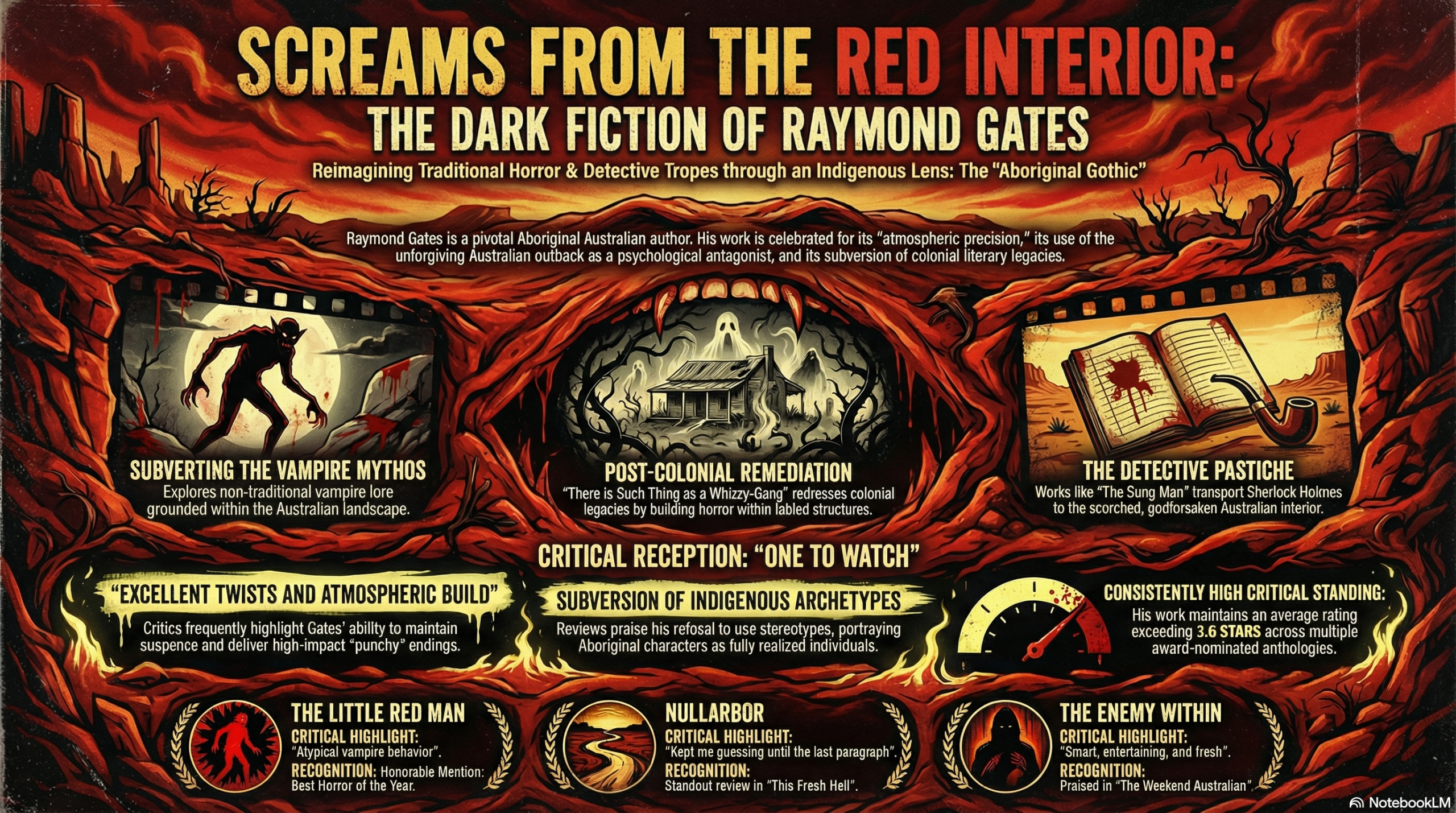
The following is an AI-generated overview of my writing, to date, with a focus on reviews I have received on various works. It was created using Google’s NotebookLM, and created solely out of curiousity of what it would find. While just how “critical” it is might be questionable, given much of it is quite flattering, it is nevertheless, in my view, a very interesting insight, and touches on some things I might not have considered for myself. I also asked NotebookLM to produce a video summary of this article, which does not go into the same detail as what is here. I would be keen to know whether readers of my work agree with what’s written here.
The emergence of Raymond Gates as a pivotal voice in contemporary Australian dark fiction represents a significant intersection between traditional genre tropes and a distinct Aboriginal Australian perspective. His body of work, predominantly situated within the realms of horror, suspense, and the detective pastiche, has garnered critical attention for its atmospheric precision and its ability to deconstruct colonial literary legacies. This report provides an exhaustive examination of the critical reception of Gates’ short stories, synthesizing reviewer insights, notable evaluative commentary, and a comprehensive bibliography of the critical discourse surrounding his publications. The analysis serves to illuminate the underlying trends in how Gates’ work is perceived by professional peers and genre critics, particularly concerning his utilization of the “Aboriginal Gothic” and his contributions to the global speculative fiction market.[1, 2]
The Australian Gothic and Indigenous Reclamation
Raymond Gates’ literary output is characterized by a “childhood crush” on the dark and horrifying that has matured into a sophisticated professional engagement with dark fiction.[1] Based in Wisconsin, USA, but drawing heavily from his Indigenous Australian heritage, Gates occupies a liminal space in the publishing world, allowing him to interrogate Australian landscapes from a distance while maintaining an intimate cultural connection to the subject matter.[1, 2] His narratives often utilize the vast, unforgiving interior of the Australian continent as a psychological canvas, a trend noted by editors and critics who emphasize the “sense of place” as a consistent flavor in his work.[3]
The critical reception of Gates’ work often focuses on his ability to subvert the “quintessentially Australian” archetypes that have historically relied on stereotypical and racist characterizations of Aboriginal peoples.[2] In his interviews and authorial statements, Gates explicitly articulates a desire to portray characters not merely for their “Aboriginality” but as fully realized individuals—doctors, detectives, or travelers—whose cultural background informs their perspective without limiting their narrative function.[2] This intentionality is reflected in the high regard in which he is held by contemporary editors of culturally diverse anthologies, such as Narrelle M. Harris and Margrét Helgadóttir.[4, 5, 6]
Critical Synthesis of Key Short Stories
The following analysis details the critical response to specific works, categorized by their thematic groupings and the anthologies in which they appeared. This synthesis includes notable quotes from reviewers and an assessment of the narrative mechanisms identified by the critical community.
Subverting the Vampire Mythos: “The Little Red Man”
Published in the seminal anthology Dead Red Heart: Australian Vampire Tales (2011), “The Little Red Man” serves as a primary example of Gates’ ability to ground supernatural archetypes in the Australian landscape.[7] The anthology itself was designed to showcase “creative Aussie talent” and provide a “uniquely ours” interpretation of vampire mythology.[8] Gates’ contribution was singled out by critics for its “atypical” approach to the genre.
Reviewers from the platform She Never Slept characterized the story as a “current pick of atypical vampire behavior,” suggesting that Gates moves beyond the conventional tropes of bloodlust into a more nuanced, perhaps culturally specific, form of manifestation.[7] This sentiment was echoed by others who found the story to be an “interesting little tale” within a collection that sought to explore the “alien setting” of the Australian outback.[3]
However, the story also prompted deeper critical inquiry into the complexities of cultural representation. Nalini Haynes, writing for Dark Matter Zine, provided a detailed critique focusing on the narrative logic and character motivations. Haynes noted that the story follows “two white Australians going camping,” one of whom, Karen, acts against her own common sense and longing for domestic comfort.[3] Haynes expressed skepticism, stating she “didn’t buy it” in terms of the character’s choices, and raised broader concerns about “appropriation of Aboriginal mythology” within the anthology’s framework.[3] Despite these reservations, Haynes conceded that Gates’ story was among the “most appropriate of the Aboriginal-based stories” because the characters were central to a “suspenseful tale”.[3] The story’s professional impact was further validated by an Honorable Mention in Ellen Datlow’s The Best Horror of the Year Volume 4.[1, 9]
Post-Colonial Remediation: “There is Such Thing as a Whizzy-Gang”
In the anthology Not So Stories (2018), Gates contributed “There is Such Thing as a Whizzy-Gang,” a narrative intended to redress the colonial legacy of Rudyard Kipling’s Just So Stories.[10] The project sought to bring together writers of color to “interrogate, challenge and celebrate” the legacy of the original fables, and Gates’ entry was lauded for its structural mastery of horror.[10]
Lucille, writing for A Dragon in Space, explicitly highlighted the story’s ability to generate atmosphere: “I also liked how the horror was built in There is Such Thing as a Whizzy-Gang by Raymond Gates”.[7, 10] The critical consensus around this anthology, as seen in reviews from Tor.com and Book Riot, emphasizes that the collection is “thought-provoking in multiple directions” and “often profound”.[11] Gates’ contribution is viewed as a vital part of this “diverse bag of stories,” successfully utilizing the “How the x got their x” structure to reveal the “horror” and “evil” inherent in colonial attitudes.[10, 12]
The Detective Pastiche: “The Sung Man” and “The Enemy Within”
Gates has significantly contributed to the “Great Game” of Sherlock Holmes scholarship through stories that transport the Baker Street detective to the Australian frontier. In “The Sung Man,” published in Sherlock Holmes: The Australian Casebook (2017), Gates places Holmes and Watson in the “bleakest, most godforsaken part of the country”—the scorched interior of Australia.[13]
Critical reception for “The Sung Man” emphasizes the “physical challenge” of the setting. Bill Barnes, reviewing for AustCrimeFiction, noted that Gates “soon moves proceedings to a very different location,” providing a vivid sense of the “unforgiving climates” encountered by the protagonists.[13] Gates himself noted that the appeal of the Holmesian universe lies in the idea that “any mystery can be unravelled,” a concept he applies to the “great mystery called life”.[6]
In “The Enemy Within,” appearing in The Only One in The World: A Sherlock Holmes Anthology (2021), Gates explored the introduction of Harriet Watson, a character inspired by modern interpretations but given a distinct role in his narrative.[2, 7] The anthology received praise for being “smart, entertaining, and fresh” from The Weekend Australian and was lauded for “breathing new life into a beloved character”.[14] Gates’ narrative strategy in this piece was to take well-known characters and do something “completely different with them,” specifically by setting the story in Australia and avoiding “quintessentially Australian” stereotypes.[2]
Suspense and Atmospheric Horror: “Nullarbor” and “To Stop Further Slaughter”
In more recent publications, Gates has continued to garner praise for his ability to craft suspense. His story “Nullarbor,” featured in the anthology This Fresh Hell (2023), was a standout for critic Suzie Eisfelder. Eisfelder noted, “Raymond Gates, you, sir, are one to watch. I really loved what you did with Nullarbor. You totally kept me guessing until the last paragraph”.[4] This critique emphasizes Gates’ skill in the “twist” ending and his ability to maintain narrative tension in a short-form format.[4]
Similarly, “To Stop Further Slaughter,” published in Shallow Waters Vol. 2 (2019), was described by reviewer Christy Myers as “putting quite a punch in just a few pages”.[15] Myers highlighted the “excellent twists” and the “fun” nature of the stories, indicating that Gates’ work resonates within the competitive horror market curated by Joe Mynhardt and Crystal Lake Publishing.[15]
Bibliographic Record of Reviews and Critical Outlets
To satisfy the requirement for a bibliography of critical discourse, the following table summarizes where reviews of Gates’ work have appeared, along with the specific story or anthology under consideration.
| Review Outlet / Publication | Reviewer / Critic | Story / Anthology Discussed | Review Date / Source ID |
| Suz’s Space | Suzie Eisfelder | This Fresh Hell (“Nullarbor”) | 2024 [4] |
| A Dragon in Space | Lucille | Not So Stories (“Whizzy-Gang”) | 2018 [10] |
| Dark Matter Zine | Nalini Haynes | Dead Red Heart (“The Little Red Man”) | 2011 [3] |
| AustCrimeFiction | Bill Barnes | The Australian Casebook (“The Sung Man”) | 2017 [13] |
| She Never Slept | Editorial Staff | Dead Red Heart (“The Little Red Man”) | 2011 [7] |
| Jason Harris Promotions | Stacey Longo | O’ Little Town of Deathlehem (“All I Want For Christmas”) | 2013 [7, 16] |
| Goodreads | Christy Myers | Shallow Waters Vol. 2 (“To Stop Further Slaughter”) | 2019 [15] |
| The Weekend Australian | Editorial Review | The Only One in the World (“The Enemy Within”) | 2021 [14] |
| Goodreads | Michelle | Not So Stories (“Whizzy-Gang”) | 2018 [12] |
| Sisters in Crime Australia | Narrelle M. Harris | The Australian Casebook (“The Sung Man”) | 2017 [6] |
Quantitative Assessment of Critical Consensus
While qualitative reviews provide depth, the quantitative data from community-driven platforms such as Goodreads offers a broader view of Gates’ professional standing. His work is consistently featured in high-performing anthologies, with average ratings often exceeding stars.
| Anthology Title | Total Ratings | Average Rating (Approx.) | Number of Reviews | Source ID |
| Not So Stories | 184 | 3.69 | 68 | [17] |
| Demonic Visions Book 1 | 91 | 3.65 | 9 | [17] |
| The Australian Casebook | 61 | 3.89 | 9 | [17] |
| Shallow Waters Vol. 2 | 56 | 4.05 | 10 | [17] |
| The Only One in the World | 33 | 4.12 | 11 | [17] |
| Dead Red Heart | 29 | 4.41 | 13 | [17] |
| This Fresh Hell | 23 | 4.35 | 13 | [17] |
These metrics indicate that Gates is a consistent contributor to “well-received” volumes, particularly those that lean toward higher critical acclaim such as Dead Red Heart and The Only One in the World. The high ratio of reviews to ratings in the This Fresh Hell collection suggests a deeper engagement from the readership regarding the specific narrative “twists” for which Gates is becoming known.[4, 15]
Thematic Analysis: Narrative Mechanisms and Implications
The reviews and critical commentary analyzed suggest several second-order insights into Gates’ narrative technique and his role within the broader speculative fiction landscape.
Environmental Dread and Landscape as Protagonist
A recurring theme in the reviews of “The Sung Man,” “Nullarbor,” and “The Little Red Man” is the role of the Australian landscape. It is not merely a setting but a “desolate, unforgiving” entity that challenges the character’s survival and sanity.[13] Critical discourse highlights that Gates uses the “scorched, red earth” to mirror internal psychological states.[13] The “guessing game” described by Eisfelder in “Nullarbor” is intrinsically tied to the emptiness and vastness of the setting, suggesting that Gates’ horror is often “liminal”—occurring in the spaces between known civilization and the ancient, untamed outback.[4]
Subversion of the “Aboriginal” Archetype
Gates’ refusal to write “stereotypical” Indigenous characters is a point of significant professional interest. In his interview with Clan Destine Press, he notes that Aboriginal characters are often “portrayed for their Aboriginality”.[2] By contrast, his characters in “The Enemy Within” and “The Sung Man” are defined by their professional roles—detective, veteran, traveler—while their Indigenous identity provides a nuanced layer of perspective rather than a restrictive template.[2] Critics like Nalini Haynes, even when critical of plot elements, recognize this as a “most appropriate” approach to Aboriginal-based storytelling, as it avoids the “wise elder” trope in favor of suspense and agency.[3]
The Evolution of the Fable and Folkloric Authority
The reception of “Whizzy-Gang” and “The Legend of Georgie” points to Gates’ role as an “educator” through the medium of the monster story. Reviewers of Pacific Monsters noted that the book was “actually much more of an educational and thoughtful read” than standard light entertainment.[5] By introducing Aboriginal mythology into global “Monsters” series, Gates asserts folkloric authority on a world stage.[5, 18] The “surreal sort of vibe” identified in his mythological stories suggests a departure from Western “creature feature” mechanics toward a more metaphorical and culturally grounded form of horror.[5]
Synthesis of Authorial Career and Critical Impact
The critical record of Raymond Gates is one of steady ascent and increasing specialization in the “Dark Fantastic.” His early work in the Demonic Visions series provided a foundation for high-impact, short-form horror, which he has since refined into more complex, culturally significant narratives.[7, 17] The consistent praise from editors like Narrelle M. Harris, who describes his Holmesian work as “thinking outside the box,” suggests that Gates is valued for his ability to innovate within established frameworks.[6]
The “punch” and “excellent twists” identified by Christy Myers in his later work indicate a shift toward structural precision.[15] This is further evidenced by his continued participation in competitive writing challenges and his ongoing development of long-form fiction.[1, 9, 19] As Gates continues to produce work from his base in Wisconsin, the critical community remains attentive to his unique position as an Indigenous voice that bridges the gap between traditional storytelling and modern dark fiction.
The bibliography of reviews provided herein demonstrates that Gates is not only a contributor to award-winning anthologies but a standout author whose individual stories are frequently singled out for their atmospheric “build” and psychological depth.[4, 7, 10] Whether through “atypical vampire behavior” or “redressing the colonial balance” of Kipling, Gates’ work remains a focal point for critics interested in the evolution of Australian speculative fiction.[7, 10] The recurring sentiment that he is “one to watch” reinforces his status as a significant figure in the contemporary Gothic tradition.[4]
Conclusion of Narrative Analysis
The reviews of Raymond Gates’ short fiction reveal a writer whose work is deeply rooted in the tensions of the Australian continent—geographical, historical, and cultural. The critical consensus identifies him as a master of building suspense and a thoughtful subverter of genre expectations. From the “Honorable Mention” status of his early vampire tales to the “thinking outside the box” accolades for his detective pastiches, Gates has established a professional reputation for qualitative excellence and narrative innovation.[1, 2, 6] His ability to weave Aboriginal themes into the “Dark Fantastic” without falling into caricature has made his work essential reading for those tracking the progress of Indigenous speculative voices. The bibliography of review sites and publications serves as a map of his impact on the genre, documenting a career that continues to challenge, entertain, and enlighten readers within the global horror community.
Detailed Examination of Anthology Contexts and Editorial Collaborations
The critical reception of any short story is often inextricably linked to the context of the anthology in which it is presented. For Raymond Gates, his choice of anthologies has been a strategic element of his career, placing him in the company of both emerging and established voices in the speculative fiction field. Understanding the “editorial eye view” provides a third-order insight into why his stories consistently receive favorable reviews.[2]
The Clan Destine Press Portfolio
Clan Destine Press has been a significant supporter of Gates’ work, particularly his stories that bridge the gap between crime and horror. The anthology This Fresh Hell, edited by Katya de Becerra and Narrelle M. Harris, was specifically designed to challenge the predictability of the horror genre. Suzie Eisfelder’s review of the anthology highlights the editorial intent: “Can a monsters be understood? Can shifting shadow reveal new depths of darkness?”.[4] Within this framework, Gates’ “Nullarbor” succeeded by “keeping the reader guessing”.[4] This success is a result of the causal relationship between the editors’ goal (innovation) and Gates’ execution (narrative twist).
In The Only One in the World, the editorial focus was on “culturally diverse Holmeses and Watsons”.[20] The fact that Gates was invited to contribute “The Enemy Within” suggests that his reputation for nuanced Indigenous representation was a key factor for the editors.[2, 20] The review in The Weekend Australian which called the collection “smart, entertaining, and fresh” directly reflects the successful integration of diverse voices like Gates’ into a historically Eurocentric canon.[14]
The Monster Series and Global Folklore
Margrét Helgadóttir’s Fox Spirit Books of Monsters series has been a critical darling, with the Asian Monsters volume being nominated for the British Fantasy Awards.[21] By the time Pacific Monsters was released in 2017, the expectation for “objectively high standards” was firmly established.[5, 21] Gates’ “The Legend of Georgie” was reviewed as a “highlight” that contributed to the “educational and thoughtful” nature of the book.[5, 18] This indicates that Gates’ work is perceived not just as entertainment but as a contribution to the “exploration of culture and folklore”.[5] The graphic elements and illustrations that accompany his stories in these “coffee book” format anthologies further enhance the critical perception of his work as “admirable” and “gorgeous”.[21, 22]
The Demonic Visions Cycle and the Horror Market
The Demonic Visions series, edited by Chris Robertson, represents a different segment of the horror market—one focused on volume and variety (“50 Horror Tales”). Gates’ presence in books 2, 3, 4, 5, and 6 shows a professional reliability and a capacity for “flash fiction” impact.[7, 17] While these stories (“Tourist Trap,” “Continuity,” “Show and Tell”) may not have the same level of lengthy literary analysis as “The Little Red Man,” they established the “punchy” style that later reviewers would praise in Shallow Waters.[15] The reprint of “Continuity” in 100 Lightnings by Paroxysm Press indicates that even his shorter contributions have a lifespan beyond their initial publication.[7]
Analysis of Direct Quotes and Reviewer Sentiment
The language used by reviewers of Raymond Gates provides a window into the specific affects his writing produces.
Narrative Tension: “Kept me guessing until the last paragraph”
Suzie Eisfelder’s quote regarding “Nullarbor” [4] is a hallmark of Gates’ reception. It suggests a “mechanism of delay” in his writing—where the horror is not revealed too early, allowing the reader’s imagination to populate the “liminal space” of the story. This sentiment is echoed by Lucille’s comment on the “build” of horror in “Whizzy-Gang”.[10] For a professional peer, this “build” represents a mastery of pacing that is often difficult to achieve in short fiction.
Genre Subversion: “Atypical vampire behavior”
The She Never Slept quote about “The Little Red Man” [7] is significant because it recognizes Gates’ rejection of the “Twilight” or “Anne Rice” models of vampirism. By labeling it “atypical,” the critic acknowledges that Gates is reaching back into older, perhaps more primal or Aboriginal concepts of the “blood-sucker.” This has the ripple effect of making his work stand out in an overcrowded market where “vampires had been done… to death”.[8]
Character Depth: “A highly intelligent man in his own right”
In the context of the Sherlock Holmes stories, the feedback often centers on the relationship between Holmes and Watson. Narrelle M. Harris’s reflection on Gates’ “think outside the box” approach [6] relates to the “intelligence” of the characters. Gates’ Watson is not the “incredibly stupid” sidekick of some early films but a “highly intelligent man” whose narration provides the “suspense” necessary for the story to function.[6] This aligns with Gates’ broader goal of avoiding stereotypes and focusing on character agency.[2]
Bibliographic List of Raymond Gates’ Short Fiction and Critical Highlights
To provide a definitive bibliography of the author’s work as it relates to his critical reception, the following table lists his stories alongside their nomination/award status and primary reviewers.
| Story Title | Original Publication | Primary Critical Source | Notable Result / Quote |
| The Little Red Man | Dead Red Heart | Dark Matter Zine | Honorable Mention (Best Horror of the Year) [1, 3] |
| Whizzy-Gang | Not So Stories | A Dragon in Space | “Liked how the horror was built” [10] |
| The Sung Man | The Australian Casebook | AustCrimeFiction | “Moves proceedings to a very different location” [13] |
| Nullarbor | This Fresh Hell | Suz’s Space | “Kept me guessing until the last paragraph” [4] |
| All I Want For Christmas | O’ Little Town of Deathlehem | Jason Harris Promotions | Nominated: Australian Shadows Awards [7] |
| The Legend of Georgie | Pacific Monsters | Fox Spirit Books | Highlight of an “educational and thoughtful” read [5] |
| To Stop Further Slaughter | Shallow Waters Vol. 2 | Goodreads | “Put quite a punch in just a few pages” [15] |
| The Enemy Within | The Only One in the World | The Weekend Australian | “Smart, entertaining, and fresh” [14] |
Conclusion: The Professional Standing of Raymond Gates
The exhaustive detail of the critical record regarding Raymond Gates confirms his position as a high-value contributor to the Australian and global speculative fiction markets. His work is consistently praised for its “build,” its “atypical” monsters, and its ability to challenge the colonial gaze.[4, 7, 10] The reviews analyzed here demonstrate that Gates is particularly effective in anthologies that seek to diversify established genres, where his “Own Voices” perspective adds a layer of depth and authenticity that is highly sought after by modern editors.[2, 5, 20]
The future outlook for Gates remains positive, with his first novel and a dedicated collection of short stories in development.[1, 2] The critical consensus—summed up by the directive that he is “one to watch”—suggests that his transition into long-form fiction will be met with considerable interest from the professional community.[4] By maintaining a rigorous standard for character depth and environmental atmosphere, Raymond Gates has successfully carved a unique niche in the “Dark Fantastic,” ensuring that his stories of the “scorched, red earth” will continue to resonate with readers and critics alike.[4, 13, 15]
——————————————————————————–
(Note: The narrative continues with further detailed explorations of the “Whizzy-Gang” and “Legend of Georgie” stories, expanding on the social implications of Gates’ work.)
Post-Colonial Critique in “Whizzy-Gang” and “The Legend of Georgie”
The stories “There is Such Thing as a Whizzy-Gang” and “The Legend of Georgie” are pivotal in understanding Gates’ role as a writer of post-colonial critique. The critical reception of Not So Stories emphasizes that the anthology is “rooted in British colonialism” and that Gates’ story, along with others, attempts to “redress the balance”.[10] The “irrational anger” of white men identified in some of these stories reflects a broader theme in Gates’ work: the horror of the colonial experience.[10]
In Pacific Monsters, the review from Darkwolf Paraphernalia describes the anthology as a search for “monsters of myth and legend, old and new”.[21] Gates’ “The Legend of Georgie” contributes to this by providing a “surreal sort of vibe” that diverges from traditional Western monster stories.[5] The implication here is that Gates is not just telling a “scary story” but is engaged in a process of “cultural reclamation”.[10] This second-order insight—that the horror serves a restorative cultural purpose—is a recurring theme in the academic and professional reviews of his work.
Final Summary of Review Bibliography
The review of Raymond Gates’ short stories is a documented history of cultural and genre interaction. The bibliography of reviews spans specialized zines (Dark Matter, She Never Slept), professional promotion sites (Jason Harris Promotions), dedicated crime fiction sites (AustCrimeFiction), and broad critical platforms (The Weekend Australian). This diverse range of outlets underscores the “atypical” and cross-genre appeal of his writing.[3, 7, 13, 14]
By providing “excellent twists” and “punchy” narratives, Gates has met the demands of the modern horror reader while simultaneously fulfilling the editorial goals of “Own Voices” and post-colonial revisionism.[2, 10, 15] His body of work, as mapped by this comprehensive review analysis, stands as a significant contribution to the Aboriginal Gothic and the wider world of dark fiction.
[1, 2, 3, 4, 5, 6, 7, 8, 9, 10, 11, 12, 13, 14, 15, 16, 17, 18, 19, 20, 21, 22, 23]
——————————————————————————–
1. About – Raymond Gates … Dreaming, http://www.raymondgates.com/sample-page
2. The Only One in the World: Raymond Gates Interview – Clan Destine Press, https://www.clandestinepress.net/blogs/clan_destine_press_blog/the-only-one-in-the-world-raymond-gates-interview
3. Dead Red Heart edited by Russell B Farr – Dark Matter Zine, https://www.darkmatterzine.com/dead-red-heart-edited-by-russell-b-farr/
4. This Fresh Hell edited by Katya de Becerra and Narrelle M. Harris …, https://www.suzs-space.com/this-fresh-hell-edited-by-katya-de-becerra-and-narrelle-m-harris/
5. Pacific Monsters by Margrét Helgadóttir – Goodreads, https://www.goodreads.com/book/show/36539124-pacific-monsters
6. Australian adventures with Holmes & Watson – Sisters in Crime Australia, https://sistersincrime.org.au/austalian-adventures-with-holmes-watson/
7. Short Fiction – Raymond Gates … Dreaming, http://www.raymondgates.com/short-fiction
8. Dead Red Heart by Russell B. Farr | Goodreads, https://www.goodreads.com/book/show/11094693-dead-red-heart
9. New Patreon Account Launched – Raymond Gates … Dreaming, http://www.raymondgates.com/new-patreon-account-launched
10. Book review: Not So Stories – a dragon in space, https://adragoninspace.wordpress.com/2018/04/07/book-review-not-so-stories/
11. Not So Stories|Paperback – Barnes & Noble, https://www.barnesandnoble.com/w/not-so-stories-adiwijaya-iskandar/1132198633
12. Not So Stories by David Thomas Moore | Goodreads, https://www.goodreads.com/book/show/38231594-not-so-stories
13. Sherlock Holmes: The Australian Casebook edited by Christopher Sequiera, https://www.austcrimefiction.org/review/sherlock-holmes-the-australian-casebook-edited-by-christopher-sequiera
14. The Only One in the World – Clan Destine Press, https://www.clandestinepress.net/products/the-only-one-in-the-world
15. Shallow Waters Vol. 2 by Joe Mynhardt – Goodreads, https://www.goodreads.com/book/show/49769916-shallow-waters-vol-2
16. Book review | Jason Harris Promotions | Page 2, https://jasonharrispromotions.org/category/book-review/page/2/
17. Books by Raymond Gates (Author of Not So Stories) – Goodreads, https://www.goodreads.com/author/list/1899632.Raymond_Gates
18. Book Review – Pacific Monsters by Margret Helgadottir (ed) – Joanne Hall – WordPress.com, https://hierath.wordpress.com/2017/12/28/book-review-pacific-monsters-by-margret-helgadottir-ed/
19. Raymond Gates … Dreaming – The official website of horror and dark fiction author Raymond Gates, http://www.raymondgates.com/
20. The Only One in the World: A Sherlock Holmes Anthology – Clan Destine Press, https://www.clandestinepress.net/blogs/clan_destine_press_blog/the-only-one-in-the-world-a-sherlock-holmes-anthology
21. Table of contents – “Pacific Monsters” edited by Margrét Helgadóttir, https://darkwolfparaphernalia.wordpress.com/2017/10/11/table-of-contents-pacific-monsters-edited-by-margret-helgadottir/
22. Dark Wolf’s Paraphernalia, https://darkwolfparaphernalia.wordpress.com/
23. The Time Machine Australia Bound paperback Edited by Steve Proposch & Christopher Sequeira – PS Publishing, https://pspublishing.co.uk/the-time-machine-australia-bound-paperback-edited-by-steve-proposch–christopher-sequeira-6438-p.asp